Banjo String Instrument Embroidery Design
A Thoughtful First Impression for Boutique Apparel
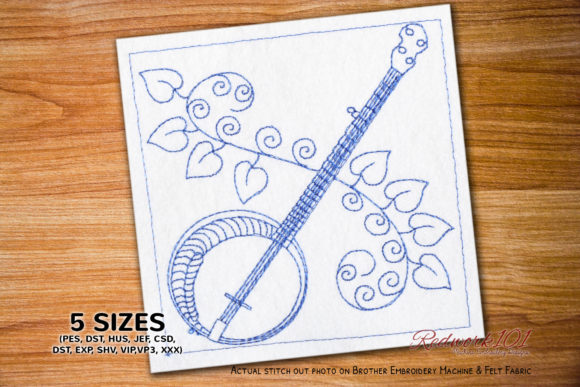
As an embroidery designer who’s developed collections for indie clothing brands and Etsy sellers for over a decade, I opened Banjo String Instrument with clear intent: to assess whether it could anchor a cohesive, market-ready sweatshirt line. Visually, it delivers immediate personality—stylishly decorated with a floral background that leans feminine but not saccharine, detailed enough to read clearly at 3–4 inches yet balanced enough to avoid visual clutter. The banjo itself has clean outlines and expressive curves; the floral elements are stylized—not botanical, not cartoonish—landing somewhere between vintage charm and contemporary craft. It feels premium without being stiff, playful without sacrificing sophistication. That balance is rare in Music-themed embroidery files—and critical when building a boutique brand identity.
How Banjo String Instrument Performs Across Apparel Types
On neutral sweatshirts (heather grey, oatmeal, soft white), Banjo String Instrument reads as intentional and elevated—ideal for chest placement on oversized crewnecks or cropped hoodies. Its moderate scale and centered composition make it equally effective on t-shirts, denim jackets, and structured tote bags. For dark garments, I recommend checking thread color contrast early: the floral background benefits from slightly richer tones (like deep sage or burgundy) to retain dimension against charcoal or navy fleece. On pastel hoodies—think mint, blush, or lavender—the design gains gentle whimsy, especially when paired with tonal stitching.
For back designs or sleeve accents, Banjo String Instrument holds up well due to its symmetrical weight and clear focal point. It doesn’t rely on tiny lettering or micro-details, so it translates cleanly even at reduced sizes (2.75”–3.25”). That makes it practical for commercial embroidery workflows where consistency across dozens of units matters. As a digital embroidery file, it avoids overly dense stitch areas—no visible “thread buildup” zones that could cause puckering on ribbed fabric or lightweight knits.
Real-World Placement & Fabric Considerations
For sweatshirt embroidery, I tested Banjo String Instrument on midweight French terry and brushed fleece. With medium-weight cutaway stabilizer, it stitched cleanly—even across curved shoulder seams. On stretchy fabric like cotton-spandex blends, I added light tear-away on top to prevent distortion during hooping. The outer box shown in the product image is optional, which gives flexibility: omit it for minimalist t-shirt looks, keep it for bold tote bag statements or lifestyle product photos where framing enhances shelf appeal.
That said, avoid placing Banjo String Instrument directly over high-stretch zones (like underarm seams or waistbands) without testing first. Also, skip ultra-fine fabrics like voile or silk unless you’re using ultra-low-density fill techniques—this isn’t a delicate, low-stitch-count design. Its strength lies in confident presence, not subtlety.
Value Beyond the Stitch: Brand, Trust, and Visual Consistency
When you choose a Creative Fabrica embroidery design like Banjo String Instrument, you’re not just licensing a motif—you’re selecting a tone of voice for your boutique brand. This design communicates warmth, creativity, and niche authenticity. Music lovers recognize the instrument instantly; floral details invite emotional connection. That duality builds buyer trust: customers feel seen, not sold to.
In Etsy listings and social media graphics, Banjo String Instrument stands out in scrollable feeds because it balances recognizability with artistic nuance. Unlike generic music notes or overused guitar silhouettes, it offers distinction—helping your small shop product gain recognition across platforms. Used consistently across sweatshirts, tote bags, and limited-run denim jackets, it becomes part of your visual signature—supporting long-term brand recall without requiring custom illustration.
Practical Designer Notes Before You Stitch
- Test on scrap fabric first—especially if embroidering on fleece, ribbed knit, or dark apparel where thread coverage can shift perception.
- Confirm stabilizer choice: medium cutaway works best for most sweatshirt embroidery; light tear-away suffices for stable cotton tees.
- Review thread color contrast carefully—some floral tones may blend into heathered backgrounds unless you adjust hue saturation or brightness.
- Check hoop size requirements before production. While the design appears compact, the optional outer box may increase footprint—verify dimensions in the Creative Fabrica embroidery file preview.
- Inspect stitch density visually in your editing software. Look for smooth transitions in petal fills and consistent banjo string definition—no skipped jumps or abrupt density shifts.
- Test on similar garment fabric before full runs. A 100% cotton hoodie behaves differently than a poly-cotton blend—don’t assume compatibility.
- Compare placement options: center-chest, left-chest, sleeve cuff, or lower-back. Each changes how the design interacts with garment drape and movement.
- Review Creative Fabrica product details and licensing thoroughly before selling finished apparel. Ensure the license covers commercial embroidery use for your intended sales volume and channels.
Final Thoughts for Handmade Business Owners
Banjo String Instrument isn’t just another Music-themed embroidery file—it’s a versatile, mood-aware asset for creative entrepreneurs who value intentionality over trend-chasing. Whether you’re launching a seasonal collection for musicians, curating cozy lifestyle merch, or building a signature line for your handmade product shop, this design bridges aesthetic cohesion and technical reliability. It performs well across apparel types, supports thoughtful branding, and invites repeat engagement—not just as decoration, but as a quiet statement of identity. For small shop owners and Etsy sellers balancing craftsmanship with scalability, Banjo String Instrument earns its place in the working library.